2014 Q4 Report

Thursday, November 6th, 2014

“THE INSIDER” QUARTERLY REPORT

“When the trees their summer splendor
Change to raiment red and gold,
When the summer moon turns mellow,
And the nights are getting cold;
When the squirrels hide their acorns,
And the woodchucks disappear;
Then we know that it is autumn,
Loveliest season of the year.”
Charlotte L. Riser

Company News

What a summer this has been. We had new equipment arrive with the addition of T-20, T-21 and TK-15. This is a sure sign our country’s economy is improving and J&S Transport’s business is growing! We have taken on additional business from Alliance, Drake, Global LLC, One Energy and Energy North. To continue providing the service our customers expect, we also brought on additional drivers: Rollace Beech, Sergio Lemus, Anthony Cartolano and George Braid. Please welcome them to the J&S Transport Team!

J&S Transport has gone to paperless Hours of Service Logs! We can all agree how much easier it is now to keep track of your on-duty hours. It took a little bit of growing pains to implement the system however, is working nicely. Or driver, Dave Harrison went through a Level II Roadside Inspection showing the State Trooper his “E-Logs”. Dave passed the inspection with flying colors ultimately improving our safety score. Our thanks to Dave who demonstrated our program works!

Do you know the “No-Zone?

No-Zones are danger areas around trucks and buses where crashes are more likely to occur. Some of those No-Zones are actual blind spots where your car “disappears” from the view of the truck or bus driver. No-Zones are danger areas around trucks and buses where crashes are more likely to occur. Some of those No-Zones are actual blind spots where your car “disappears” from the view of the truck or bus driver.

SIDE NO-ZONES

Don’t “hang out” on either side of trucks or buses! They have big blind spots on both sides. If you can’t see the driver’s face in his side view mirror, he/she can’t see you. If that driver needs to change lanes for any reason, you could be in big trouble!

REAR NO-ZONE

Avoid Tailgating! Unlike cars, trucks and buses have huge No-Zones directly behind them. The truck driver cannot see your car back there and you can’t see what’s going on ahead of the truck or bus. If that vehicle stops suddenly, you have no place to go!

FRONT NO-ZONE

Pass Safely! Do not cut-in front of the commercial motor vehicle too soon after passing.
Trucks and buses need nearly twice the time and room to stop as cars. Look for the whole front of the truck in your rear-view mirror before pulling in front, and then don’t slow down!

BACKING UP NO-ZONE

Pay Closer Attention! Never cross behind a truck that is backing up! Truck drivers do not have a rear-view mirror and may not see you cutting in behind them!

WIDE RIGHT TURN NO-ZONE

Avoid the squeeze play! Truck and bus drivers need to swing wide to the left in order to safely make a turn. They can’t see cars squeezing-in between them and the curb. Watch for their turn indicators giving them the room to turn.

Safe Trick or Treating Tips

The Center for Disease Control (CDC) recommends the following safety tips:

• Swords, knives and similar costume accessories should be short, soft and flexible.
• Avoid trick-or-treating alone. Walk in groups or with a trusted adult.
• Fasten reflective tape to costumes and bags to help drivers see you.
• Examine all treats for choking hazards and tampering before eating them.
• Hold a flashlight while trick-or-treating to help you see and others to see you.
• Always test make-up in a small area first. Remove before bedtime.
• Look both ways before crossing the street. Use crosswalks when you can.
• Lower your risk for serious eye injury by not wearing decorative contact lenses.
• Only walk on sidewalks or the far edge of the road facing traffic.
• Wear well-fitting masks, costumes and shoes to avoid blocked vision and falls.
• Eat only factory wrapped treats. Avoid eating homemade treats made by strangers
• Enter homes only if you are with a trusted adult & visit well lit houses.
• Never walk near lit candles. Be sure to wear flame-resistant costumes.

Healthy Choices

Roasted Cauliflower with Cheddar Cheese Sauce

Ingredients
• 1 large head cauliflower (about 1 pound total)
• 4 tablespoons (1/2 stick) unsalted butter
• 1/4 cup all-purpose flour
• 1/8 teaspoon fine sea salt
• 2 cups whole milk
• 10 ounces Cheddar cheese or similar, grated (about 1 1/4 cup)
• Special equipment:12- by 8-inch baking dish
Preparation
Position a rack in the middle of the oven and preheat to 375°F. Arrange a steamer rack over a large pot of boiling water.
Remove the green outer leaves from the cauliflower, place it on the steamer rack, and steam until tender, about 10 minutes. Transfer to a large bowl to cool. Once the cauliflower is cool enough to handle, use your hands to gently break the florets from the thick central stalk—try to break the cauliflower into large florets rather than small pieces. Arrange the florets, in one layer, in a 12- by 8-inch baking dish and set aside.
In a large heavy saucepan over moderate heat, melt the butter. Reduce the heat to low, add the flour and salt, and whisk until both are incorporated and the mixture turns golden brown, about 2 minutes. Raise the heat to moderate and add the milk, whisking constantly, until a smooth sauce forms (the sauce should be thick and glossy, but still runny), about 5 minutes. (If the sauce is too thick, gradually whisk in additional milk until the desired consistency is achieved.) Add 1 cup of the grated cheese and whisk until melted, about 1 minute. Pour the cheese sauce over the cauliflower, making sure to cover all the florets. Sprinkle with the remaining 1/4 cup cheese and season with pepper, then bake until the cauliflower is golden brown and the cheese sauce is bubbling, about 30 minutes.
Nutrition information
Per serving (8 servings)
• Calories259 Carbohydrates9 g (3%)
• Fat20 g (30%) Protein12 g (25%)
• Saturated Fat12 g (61%) Sodium301 mg (13%)
• Polyunsaturated Fat1 g Fiber1 g (5%)
• Monounsaturated Fat5 g Cholesterol59 mg (20%)

2014 Q3 Report

Thursday, November 6th, 2014

“THE INSIDER” QUARTERLY REPORT

A New Season

Another New England summer is upon us. School is out, employees are taking much needed vacations; hitting the water to fish, water ski, vegetating on the beach or heading to Camp. This time of year puts many more vehicles on the road, including motorcycles. Your driving skills, patience, and commitment to safety are going to be tested as summer moves along. All of you are professional drivers. Put safety first and let’s enjoy what summer brings.

Company News

EOBDR’s – By now, all units have the EOBDR’s installed with the majority of drivers using them. It has been a work in progress with corrections being made as we move along. Once everyone is comfortable using the system and kinks get worked out, will we stop using paper logs. I will let you know when that times come.

Our Annual Meeting was a great success. We are so proud to have two (2) Drivers of the Year. Eric Johnson and Jim Donovan are to be congratulated for their professionalism and commitment to safety. The Company would like to see all our drivers accept this award during our next Annual Meeting.

John Hamel has been involving himself more deeply with the Massachusetts Motor Transportation Association. His Legislative Committee is addressing those issues which impact our Industry. Many of you may not realize that John was interviewed on WBZ TV to discuss the issue of unsafe drivers and trucks on the Commonwealth of Massachusetts’ roadways. You can type in the following URL on your computer browser to watch the interview:

http://boston.cbslocal.com/2014/05/13/i-team-unsafe-trucks-on-mass-roadways/

Safety Steve has been busy as well. Much of his time has been spent being the Chairman of the 2014 MA Truck Driving Championships, Chairman of the MMTA Safety and Compliance Committee and as the Eastern Regional Chairman for the National Tank Truck Carrier Association’s Safety and Security Council. Steve traveled to San Antonio, TX to accept the Grand Safety Award presented to J&S Transport. This award was earned by the Professional Drivers of J&S Transport and will be proudly displayed. While in San Antonio, Safety Steve was notified of his election to the MMTA Board of Directors.

J&S Transport has positioned itself to be a player when addressing those issues affecting our Industry, something our competitors have not done. We hope to see great improvements with our Industry is the years to come.

Fire Safety at Home

Too many news stories are on TV and in newspapers documenting fires which kill, injure and leave people homeless. Although deaths and injuries from residential fires have decreased in the past several years, deaths from fires and burns are still the 3rd leading case of fatal home injuries as determined by the Center for Disease Control. 70% of those deaths are from smoke inhalation. The National Safety Council has determined that two-thirds of deaths from residential fires occurred in homes with no smoke alarms or no working smoke alarms.

Fires are more likely to happen in certain areas or by certain equipment in your house. Be extra careful while you are cooking, smoking, being around candles, furnaces, electrical cords, fireplaces, and with children, toddlers and babies nearby. According to the U.S. Fire Administration, cooking equipment, most often a range or stovetop, is the leading cause of reported U.S. home fires and home fire injuries.

The National Safety Council recommends you follow these tips to protect your family, pets and home from fire:

➢ Have a properly working smoke alarm
• Change the battery once a year and change the whole unit every 10 years
• Smoke alarms should be in every floor of your house (including the basement) and outside bedrooms or sleeping areas
• Test your smoke alarms on a monthly basis
• Make sure your kids are familiar with the sound of the alarm

➢ Plan a family escape route
• Practice it on a monthly basis
• Practice with everyone in your family, even children, toddlers and infants
• Practice from every room in the house

➢ Learn how to use your fire extinguisher
• Use a fire extinguisher when a fire is contained, like in a waste basket
• Keep your fire extinguisher in an easily accessible place
• Call your local fire department if you have questions on how to use a fire extinguisher
• Fire extinguishers have gauges on them indicating when they need to be replaced. They need to be checked regularly to make sure they are still functional

➢ If a fire occurs in your home
• Never open a door that feels hot. Escape another way
• Take the safest route, but if you have to go through smoke, crawl low and under the smoke. Cover your nose and mouth with a moist towel (if possible) or an article of clothing
• Immediately leave your house, and then call for help
• Once you are out, stay out. Don’t go back in, not even to grab someone else

Healthy Choices

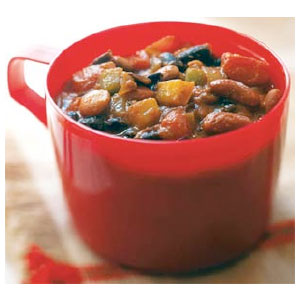
Here is a healthy vegetarian recipe from the American Heart Association: Sweet Potato & Black Bean Chili

Make a double batch of this quick vegetarian chili, full of black beans and sweet potatoes, and eat it for lunch the next day or freeze the extras for another night. We love the smoky heat from the ground chipotle, but omit it if you prefer a mild chili. Serve with tortilla chips or cornbread and coleslaw.
Ingredients
1 tablespoon plus 2 teaspoons extra-virgin olive oil
1 medium-large sweet potato, peeled and diced
1 large onion, diced
4 cloves garlic, minced
2 tablespoons chili powder
4 teaspoons ground cumin
1/2 teaspoon ground chipotle chile (see Cooking Tips)
1/4 teaspoon salt
2 1/2 cups water
2 15-ounce cans black beans, rinsed
1 14-ounce can diced tomatoes
4 teaspoons lime juice
1/2 cup chopped fresh cilantro

Cooking Instructions
Heat oil in a Dutch oven over medium-high heat. Add sweet potato and onion and cook, stirring often, until the onion is beginning to soften, about 4 minutes. Add garlic, chili powder, cumin, chipotle and salt and cook, stirring constantly, for 30 seconds. Add water and bring to a simmer. Cover, reduce heat to maintain a gentle simmer and cook until the sweet potato is tender, 10 to 12 minutes.

Add beans, tomatoes and lime juice; increase heat to high and return to a simmer, stirring often. Reduce heat and simmer until slightly reduced, about 5 minutes. Remove from heat and stir in cilantro.

Nutritional Analysis
Per serving
Calories Per Serving
319
Total Fat
8 g
Saturated Fat
1 g
Monounsaturated Fat
5 g
Sodium
518 mg
Carbohydrates
54 g
Fiber
15 g
Protein
12 g
Calcium
Potassium
1036 mg

2014 Q2 Report

Thursday, November 6th, 2014

“THE INSIDER” QUARTERLY REPORT

SPRING!!!

A New Season

Another New England winter has bid us adieu allowing the promise of warmer weather, opened windows for fresh air, planting of gardens, greening the lawn and being thankful for surviving the brutal winter. As a professional driver, this winter has taxed every ounce of your truck driving skills; creating stress and fatigue. Now that the snow and ice are gone with the warm sunshine, the professional driver cannot let their guard down having complacency take over their driving behavior. You must keep your skills sharp as those motorists who taxed those skills this past winter will still on the road with the only difference having the top down on their convertibles. Continue to drive like the professionals you are!

Company News

EOBDR’s – J & S Transport has made the decision to outfit the fleet with electronic onboard data recorders provided by Reltima. Our current GPS program is a Reltima product and we look forward to having both systems interface, especially with our Dispatching system provided by Creative Energies. Only until everyone is comfortable with the system we will discontinue the use of paper logs.

We want to welcome our new professional drivers to the J & S Transport Team; Tim Stetson, Mike Bain, Greg Jackson and Tyrone Abreu. Tim comes to us having worked for Triumvirate Environmental and Lily Corporation. Mike recently worked at DM Kolodziej Trucking while Greg comes to us from First Call Trucking. Tyron had been with A L Prime. We look forward to a long, productive and rewarding relationship with our new teammates.

Preventing Prescription Drug Overdoses

Did you know that prescription drug overdoses are one of the fastest growing causes of injury deaths as reported by the National Safety Council? It is true! According to the Center for Disease Control, more than 15,000 people die annually from overdosing on prescription drugs. Prescription pain relievers contribute to more deaths than all illegal drugs like heroin and cocaine. The National Safety Council states that most fatal drug overdoses result from pain relief medications known as opioid analgesics. Opioids include: oxycodone, methadone, hydrocodone, fentanyl and buprenorphine. Mixing prescription pain medication with alcohol and/or over-the-counter pain medications increases the risk of a fatal overdose.

Here are some interesting statistics:

➢ Among people 35 to 54 years old, unintentional drug overdoses cause more deaths than motor vehicle crashes.
➢ More than 70% of people who abused prescription pain relievers report getting them from friends and relatives.
➢ In 2010, more than 400,000 emergency room visits were made related to prescription pain relievers.
➢ Nonmedical use of prescription painkillers cost health insurers up to $72.5 billion annually in direct health care costs

Off-the-Job Injuries

Workers in the United States are safer on the job than in their homes and communities. Home and community deaths are up 75% According to the “National Safety Council 2011 Injury Facts”, for every worker killed on the job, approximately 15 workers are killed off the job. Nearly 3 times as many workers suffer nonfatal injuries off the job as compared to on the job. The take-a-way here is being well aware of the dangers at home as on the job.

Revisiting Ban on Cell-Phones by Commercial Motor Vehicle Drivers

The rules impose sanctions for driver offenses, including civil penalties up to $2,750 and disqualification for multiple offenses. Motor carriers are also prohibited from requiring or allowing their drivers to text or use a hand-held mobile phone while driving and may be subject to civil penalties up to $11,000. Violations will impact SMS results. Texting and calling on a hand-held phone carry the worst possible violation severity weights against a driver’s results!
Besides penalties and possible disqualification, recent research shows that the odds of being involved in a safety-critical event (e.g., crash, near-crash, unintentional lane deviation) are 23.2 times greater for CMV drivers who text while driving than for those who do not. Texting drivers took their eyes off the road for an average of 4.6 seconds. At 55 mph, this equates to a driver traveling the approximate length of a football field — without looking at the roadway! For CMV drivers who dial a mobile phone while driving, the odds of being involved in a safety-critical event are six times greater than for those who do not. Why take chances?

Healthy Choices

Here is a healthy chicken recipe from the American Heart Association

Oven-Fried Chicken

Description
Great news—crunchy, flavorful fried chicken can be healthy with this oven-fried chicken recipe. We marinate skinless chicken in buttermilk to keep it juicy. A light coating of flour, sesame seeds and spices, misted with olive oil, forms an appealing crust during baking. And with only 7 grams of fat per serving in this oven-fried chicken recipe—rather than the 20 in typical fried chicken—that is good news.

Ingredients
1/2 cup nonfat buttermilk (see Cook Tips)
1 tablespoon Dijon mustard
2 cloves garlic, minced
1 teaspoon hot sauce
2 1/2-3 pounds whole chicken legs, skin removed, trimmed and cut into thighs and drumsticks
1/2 cup whole-wheat flour
2 tablespoons sesame seeds
1 1/2 teaspoons paprika
1 teaspoon dried thyme
1 teaspoon baking powder
1/8 teaspoon salt
Freshly ground pepper to taste
Olive oil cooking spray
Cooking Instructions
Whisk buttermilk, mustard, garlic and hot sauce in a shallow glass dish until well blended. Add chicken and turn to coat. Cover and marinate in the refrigerator for at least 30 minutes or for up to 8 hours.

Preheat oven to 425°F. Line a baking sheet with foil. Set a wire rack on the baking sheet and coat it with cooking spray.

Whisk flour, sesame seeds, paprika, thyme, baking powder, salt and pepper in a small bowl. Place the flour mixture in a paper bag or large sealable plastic bag. Shaking off excess marinade, place one or two pieces of chicken at a time in the bag and shake to coat. Shake off excess flour and place the chicken on the prepared rack. (Discard any leftover flour mixture and marinade.) Spray the chicken pieces with cooking spray.

Bake the chicken until golden brown and no longer pink in the center, 40 to 50 minutes.

Nutritional Analysis
Per serving
Calories Per Serving: 224
Total Fat: 7 g
Saturated Fat: 2 g
Monounsaturated Fat: 2 g
Cholesterol: 130 mg
Sodium: 237 mg
Carbohydrates: 5 g
Fiber: 1 g
Protein: 34 g
Potassium: 400 mg


2014 Q1 Report

Thursday, November 6th, 2014

“THE INSIDER”
QUARTERLY REPORT

Happy New Year

Wow! A new year has started for J & S Transport. Where did 2013 go?! I am sure many of us have made resolutions for 2014. Our resolution, as a company, is continue operating safely, meeting and exceeding our customers’ expectations and allowing our employees to provide for their families and loved ones. We wish everyone a safe and prosperous new year!

Company News

We are very pleased with our new team mate who joined us last quarter. Please welcome our new ace mechanic Mark DeGregorio. Mark, who really needs no introduction, will now take care of our equipment full time. Please introduce yourselves to Mark, welcoming him to the team.

How does it feel not having to back out of Stop & Shop, across Washington Street, into the yard now? Did you hear that huge sigh of relief coming out of Safety Steve’s office? The yard renovation is complete, more room to maneuver with better parking. It is no longer necessary for Bob Hoyt to play “Flight Deck Control Officer”, jockeying equipment around daily. We can all agree the renovation was a huge success.

DOT Regulatory Changes for 2014

Did you Self–Certify your Medical Card with the State issuing your CDL? The Federal Motor Carrier Safety Administration has required CDL holders to inform their Registry or Department of Motor Vehicles of the type of commerce in which you operate and whether or not you are required to hold a medical certificate. The initial self-certification must be completed by January 30. 2014. J & S Transport drivers are classified “Non-Exempt Interstate” (NI) CDL holders and must self-certify prior the deadline of 1/20/2014 and then every time a new medical card is issued. In the future, the medical card will be electronically connected to the CDL with the driver not having to carry the medical card. Until then, make sure you self-certify or risk having your operator’s license downgraded from a CDL-A to a Class D license. See Safety Steve if you have any questions.

Truck Drivers and Prostate Cancer

The Los Angeles Times recently printed an article by Karen Kaplan that may connect prostate cancer to driving a truck. It seems that everything we do nowadays causes cancer. The take-a-way here is to use common sense and have your prostate checked annually. Below is the article in its entirety.
“Warning: Driving a truck for a living can be hazardous to your health — if you are diagnosed with prostate cancer, researchers said Tuesday.

Prostate cancer is the most common type of cancer diagnosed in men, and in most cases it’s basically harmless. As the National Cancer Institute says, even patients who never get their tumors treated are likely to die of something other than prostate cancer. So, instead of looking at prostate cancer risk, the researchers who did the new study focused on the risk that the cancer would be aggressive at the time of diagnosis.

They had a hunch that truck drivers might be vulnerable, because previous studies had suggested that long-term exposure to the kind of “whole-body vibration” endured by men working with heavy equipment could increase prostate cancer risk. It’s not clear why this would be, but one possibility is that the vibration prompts the body to produce more testosterone, which is a known risk factor for prostate cancer, according to a 2012 study published in the Annals of Occupational Hygiene. Another is that vibration can lead to prostatitis, or inflammation of the prostate gland, which may also be linked to prostate cancer, according to the American Cancer Society.

The research team — from the NCI, the Louisiana State University School of Public Health, the University of North Carolina in Chapel Hill and the Roswell Park Cancer Institute in Buffalo, N.Y. — looked at medical records and other data from 2,132 men who were part of the North Carolina-Louisiana Prostate Cancer Project. Along with other health and demographic information, they told interviewers about the two jobs where they had spent the most time in their careers, as well as their most recent job at the time of their diagnosis.

When the researchers crunched the numbers, they found that men who said they spent more time driving a truck than doing anything else were nearly four times more likely than educators to be diagnosed with a prostate cancer considered highly aggressive. (The educators were used as the baseline group because they were deemed to have pretty much no exposure to whole-body vibration.) These aggressive cancers had a PSA level greater than 20 nanograms per milliliter of blood, a Gleason sum of at least 8, or a combination of a Gleason sum of at least 7 and tumors that were stage T3/T4.

Truck driving had the strongest link to an increased risk of aggressive prostate cancer, but it wasn’t the only occupation associated with higher risk. The researchers also found that men who worked at a garden shop for at least six months were 2.33 times more likely than educators to be diagnosed with highly aggressive prostate cancer. That might be due to exposure to pesticides, although men who worked as landscapers, exterminators or in other jobs that involve pesticides were not found to have a heightened risk of aggressive prostate cancer.”

Cruise Control & Winter Driving

All J & S Transport power units and most of our personal owned vehicles are equipped with Cruise Control. For most of us, using cruise control is second nature; saving fuel costs, preventing leg fatigue and keeping us from unwittingly getting speeding tickets. What a great convenience! However, very dangerous to use for winter driving. Using cruise control in snow, ice and rain is dangerous because when the vehicle skids or hydroplanes, the vehicle sensors will sense a loss of speed and in turn, increase acceleration, rapidly spinning the wheels attempting to maintain a constant speed. When this happens, the driver can lose control of the vehicle. The best advice is not use the vehicle’s cruise control during inclement weather.

Winter Storm Preparedness

When watching the Weather Channel or listening to the weather on the radio, do you know the various levels of warning the Meteorologist refers to on an approaching storm? Here is what they mean:

Winter Storm Outlook – Winter storm conditions are possible in the next 2 to 5 days

Winter Weather Advisory – Winter weather conditions are expected to cause significant inconveniences and may be hazardous. When caution is used, these situations should not be life threatening

Winter Storm Watch – Winter storm conditions are possible within the next 36 to 48 hours. People in a watch area should review their winter storm plans and stay informed about weather conditions

Winter Storm Warning – Life-threatening, severe winter conditions have begun or will begin within 24 hours. People in warning area should take precautions immediately

Healthy Choices

Now what everyone is waiting for!! A delicious, healthy recipe: Loaded Cauliflower (a healthier alternative to mac & cheese)

1 head of cauliflower
1 brick of marble cheese
1/2 pack of ready cooked bacon crumbled
2 tbsp of real brick butter
salt & pepper to taste
sour cream

boil cauliflower until tender, drain, put cauliflower in a pam sprayed casserole dish and chop. Mix in butter and salt & pepper to taste. Sprinkle crumbled bacon over the top. Then sprinkle the cheese evenly over the top. Bake at 375 until the cheese is nice and gooey. You can serve with sour cream (optional).

“THE INSIDER” QUARTERLY REPORT

Friday, September 28th, 2012

Where Did the Summer Go?
It’s hard to believe that summer is over and schools have started another academic year. We all must focus our attention to increased commuter traffic on the roadways. Commuter traffic includes school children walking to school, waiting at school bus stops, stopped school buses and while traveling through school zones. Children are our most precious commodity, to be protected at all costs. Be diligent, aware of your surroundings by keeping your eyes moving. Have safe and enjoyable holidays!

Snow and Ice Are Coming – Is Your Car Ready?

With school back in session and finishing raking leaves; we must also turn our attention to Old Man Winter and be prepared for what he brings weather wise. The National Safety Council suggests the following checklist to prepare your car for winter:

• Checking the ignition, brakes, wiring, hoses and fan belts
• Changing and adjusting the spark plugs
• Checking the air, fuel and emission filters and PCV valve
• Inspecting the distributer or fuel injection system
• Checking the battery
• Checking the tires for air pressures, tire wear and tread depth
• Checking antifreeze level in the radiator
• Keeping large grit sand or kitty litter in your trunk to use when traction is needed
• Checking to see if the windshield wipers work and in good condition
• Headlights clean enough to allow proper visibility
• Checking the defroster, removing clutter from around the vents for better air flow
• Keeping more than a quarter tank of gas at all times
• Keeping flashlights, warm blankets readily available if you are stranded
• Keep cellular phones fully charged prior to traveling in inclement weather

Driving in Adverse Conditions

It’s inevitable, snow and ice are coming. Failure to adjust to adverse conditions is a major factor in accident frequency. The adverse conditions most frequently encountered are reduced traction and reduced visibility. Both conditions require the driver to continually maintain control of their vehicle. Do you know that using your vehicle’s cruise control during reduced traction conditions (snow, ice, & rain) can be hazardous to your health? It is true! The only way to stop wheels from spinning while maintaining control of the vehicle is to immediately reduce power to the wheels. An activated cruise control system applies continuous power, keeping the wheels spinning. If you experience a spin, by the time you disengage the cruise control, it may be too late – you may have already lost control. It has been shown when additional power is provided to the spinning wheel and the wheel hits dry pavement, the vehicle may be launched airborne. Safety Steve needs not tell you what happens when tires leave the road. Disengage your cruise control during inclement weather.

Here are a few facts for drivers on slick roads:

o Road surfaces covered with snow and ice are more slippery at 32 degrees Fahrenheit that at 0 degrees Fahrenheit
o Even a dusting of snow or light drizzle can make roads treacherous
o Black ice is particularly treacherous. It occurs at temperatures between 40 degrees Fahrenheit and 25 degrees Fahrenheit and the road surface ahead looks black and shiny.
o Black ice often occurs on shaded areas of the road, bridges and overpasses; long after the sun has come out.

Company News

We want to welcome our new J & S Transport Team Members while saying good bye to another. Robert D’Ambra (Bobby D) has decided to hang up the hoses for good and join the retired ranks. We want to thank Bobby D for his years of service with J & S Transport. Bobby will be missed! Please join the company in welcoming Fernando Rozo, Will Alvarado, Mark Herra and Jay Alper as our newest team members. All have extensive experience in the petroleum transportation industry. We look forward to having these professional drivers being part of our Team!

John Hamel has been actively involved with MA Motor Transport Association’s initiatives to address the City of Boston’s Hazardous Material Routes with the State Legislature. One of the initiatives was to have the State Legislature approve a Transportation Bond Bill which included a regional hazardous materials study addressing the validity of Boston’s Hazmat Route. Through John’s hard work studying Federal, State and Boston Regulations; lobbying with State Senators and Representatives; countless meetings with MMTA; the Transportation Bond Bill was passed by the State Legislature and signed into law by Governor Patrick. This newly signed law mandates a budgetary line item for $300,000 for MassDOT to retain an independent, third party, nationally recognized consultant in hazmat transportation routing risk analysis. This consultant is to conduct a regional hazardous transportation routing risk analysis which: (i) addresses the safe and efficient transportation of hazardous materials through and around the greater metropolitan Boston area; (ii) addresses the public safety capabilities, environmental considerations and infrastructure capacities; and (iii) makes recommendations of hazardous materials while safeguarding impacted communities.

I believe we can all give John Hamel a pat on the back for a job well done with a resounding OOH-RAH!

Healthy Choices

I believe we can agree that Safety Steve, in addition to a couple of fellow employees hold the title for being the oldest members of J & S Transport. We old timers can attest to the aches and pains of shoveling snow. Here are a few tidbits of advice when you decide to tackle snow drifts:

• Individuals over the age of 40, or those relatively inactive, should be especially careful
• If you have a history of heart trouble, do not shovel without your doctor’s permission
• Do not shovel after eating or while smoking
• Take it slow! Shoveling, like lifting weights, can raise your heart rate and blood pressure dramatically; so pace yourself. Be sure to stretch and warm up your muscles before taking on the task.
• Shovel only fresh snow. Freshly fallen, powdery snow is easier to shovel than the wet, packed down variety.
• Push the snow as you shovel. It’s easier on your back than lifting the snow out of the way
• Don’t pick up too much at once. Use a small shovel or only one fourth or one half of a larger one
• Lift with your legs bent, not your back. Keep your back straight. By bending and “sitting” into the movement, you’ll keep your spine upright and less stressed. Your shoulders, torso and thighs can do the work for you
• Do not work to the point of exhaustion. If you run out of breath, take a break. If you feel tightness in your chest, stop immediately
• Dress warmly. Remember that your extremities, nose, ears, hands and feet need extra attention during winter’s cold. Wear a turtleneck sweater, cap, scarf, face protection, mittens, wool socks and waterproof boots.

After shoveling all that snow, here is a healthy recipe for you to warm your bones:

Chunky Vegetarian Chili

Nutritional Information

Amount per serving
• Calories: 257
• Calories from fat: 9%
• Fat: 2.7g
• Saturated fat: 0.3g
• Monounsaturated fat: 0.5g
• Polyunsaturated fat: 1.2g
• Protein: 12.8g
• Carbohydrate: 48.8g
• Fiber: 14.2g
• Cholesterol: 0.0mg
• Iron: 4.5mg
• Sodium: 876mg
• Calcium: 150mg

Ingredients

• 1 tablespoon vegetable oil
• 2 cups chopped onion
• 1/2 cup chopped yellow bell pepper
• 1/2 cup chopped green bell pepper
• 2 garlic cloves, minced
• 1 tablespoon brown sugar
• 1 1/2 tablespoons chili powder
• 1 teaspoon ground cumin
• 1 teaspoon dried oregano
• 1/2 teaspoon salt
• 1/2 teaspoon black pepper
• 2 (16-ounce) cans stewed tomatoes, not drained
• 2 (15-ounce) cans black beans, rinsed and drained
• 1 (15-ounce) can kidney beans, rinsed and drained
• 1 (15-ounce) can pinto beans, rinsed and drained

Preparation
1. Heat the oil in a Dutch oven over medium-high heat. Add onion, bell peppers, and garlic; sauté 5 minutes or until tender. Add sugar and remaining ingredients, and bring to a boil. Reduce heat, and simmer 30 minutes.

Quarter 3 2012 Newsletter

Thursday, July 19th, 2012

Long Time, No See!

Remember me? I am the new edition of the “Insider” which you probably haven’t seen for a while. Our apologies for the hiatus but I’m back to provide news about J & S Transport, our industry, with a major focus on SAFETY. Steve Powers (a.k.a. Safety Steve), you know our somewhat new Safety Director, has settled into the job and thinking of ways to keep J & S Transport’s employees safe. Steve was using a monthly Driver Letter to spread awareness but soon discovered our newsletter was not being used. Steve then thought, why don’t we do both giving J & S Transport’s family a venue to share information and awareness? We can always use your feedback, input and ideas to ensure continuous improvement.

Safety Committee

Your Safety Committee has new members. Jim Donovan and Bill Hinchliffe were elected to the seats vacated by Carlos Olivar and Wayne Lee. Our sincerest appreciation goes to Carlos and Wayne for their years of service to the Committee. Standing members include Steve Powers, Bob Hoyt, John Hamel and Sharon Hamel. We cannot stress enough having Jim and Bill be your conduit to bring issues to the committee. For those employees who are not comfortable talking with management, this is an excellent means to make your concerns known.

Industry News

We are all aware of the new Boston Hazmat Route. John Hamel has provided extensive insight to the new regulations and his expectations for all our drivers. Any questions you continue to have, please let John know.

Congress passed a version of the long awaited Highway Bill. Our industry was closely watching to see how the “Wetline” issue would proceed. Thankfully, the new Bill provides a temporary ban on the ability of the U. S. Department of Transportation to issue a final rule to ban wetlines–flammable product in the unloading lines of cargo tanks. That rule was on the DOT regulatory agenda for action by the end of this fall. If allowed, our industry would have to alter the piping on the undercarriage of the tanker to eliminate any product residue from being in those lines; a very expensive undertaking for any tanker fleet!

All drivers are aware of the Final Ruling issued by the Federal Motor Carrier Safety Administration regarding Hours of Service. The Ruling becomes effective on July 1, 2013 with the key changes include limiting restarts to once per week with the restart covering at least 34 hours including 2 periods between 0100 and 0500. You will be receiving more information as we determine how best to comply with this new regulation.

Company News

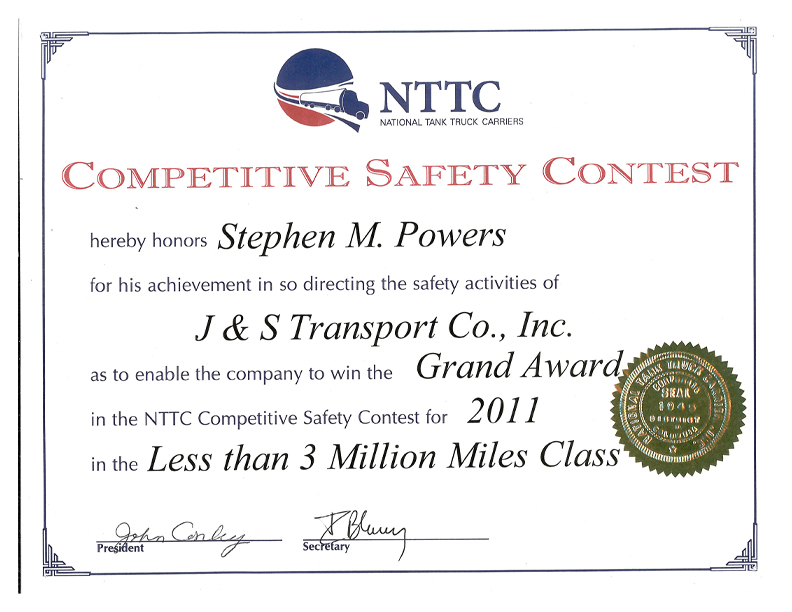
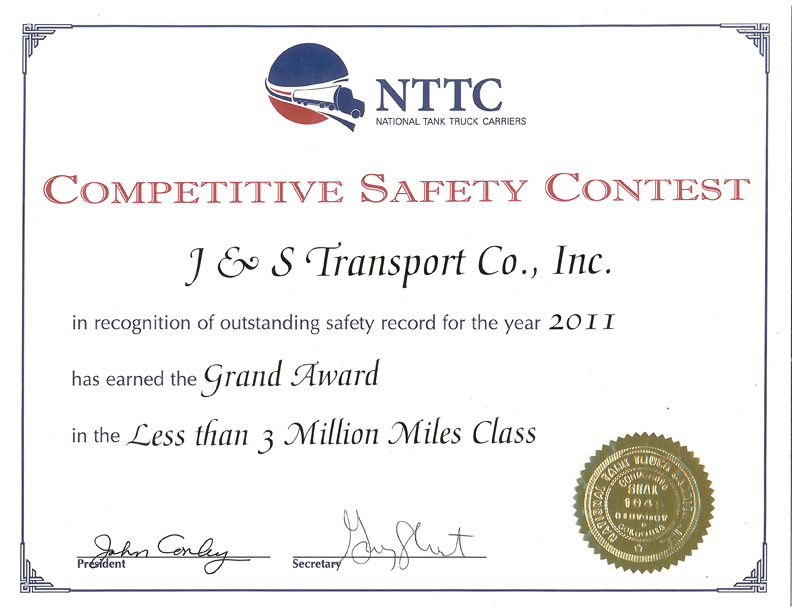
John and Sharon Hamel went to the Annual National Tank Truck Carrier Meeting in San Francisco, CA. The highlight of the meeting is when our industry recognized J & S Transport with the 2011 Grand Competitive Safety Award. None of this recognition would have been possible without you, the professional driver, operating our transport vehicles.

John Hamel was elected to the Board of Directors for Massachusetts Motor Transport Association. John also was appointed to the Executive Committee and the Legislative Committee for the Association. We can all rest assured that John will keep the interests of our industry in the forefront on Beacon Hill. Safety Steve was named to the Safety Council of MA Motor to share his knowledge and experience among the membership.

Healthy Choices

All Commercial Motor Vehicle Drivers need to undergo recurring medical physicals in order to be certified to drive for J & S Transport. One emphasis the DOT is placing on examining physicians is to check for Obstructive Sleep Apnea (OSA). They do this by asking if the driver snores a lot, awakes frequently or has any other sleeping disorder. The other way they check is to measure the driver’s Body Mass Index (BMI). If the BMI is above a specified limit, the physician may require the driver to participate in a sleep study at a certified sleep lab. If the driver is diagnosed with OSA, he may have additional requirements to complete prior issuing of a new medical card. One factor of OSA is the driver’s weight.

As part of this Newsletter, we will include a healthy yet tasty recipe to try. If you, or your family, have “sure winner” recipes to share with the rest of us, please bring them in. This issue’s recipe is for:

2nd
Skillet Pizza Chicken

Ingredients:
1 egg white
¼ cup buttermilk
¼ cup grated Parmesan cheese
1 teaspoon dried oregano
1 teaspoon dried basil
½ cup all-purpose flour
½ cup bread crumbs
2 pounds skinless, boneless chicken breasts, pounded thin
2 cups tomato pasta sauce
1 cup shredded part-skim Mozzarella cheese
Pasta, cooked
Directions:
1. In a shallow bowl, combine the egg white and buttermilk, beating lightly.
2. On a plate, combine the Parmesan cheese, oregano, basil, flour, and bread crumbs. Dip each piece of chicken in the egg and then in the flour mixture, making sure to completely coat each piece. Set the chicken aside.
3. Heat a large non-stick skillet coated with non-stick cooking spray over medium heat. Add the chicken, and cook until lightly browned. Turn the chicken, and cook several more minutes or until almost done. Lower the heat, and cover the chicken with pasta sauce. Top with the Mozzarella; cover and cook several more minutes, or until cheese is melted. Serve over a bed of pasta.
Serves 6
Per serving*
Calories: 361
Total Fat: 8 g
Sat: 4 g
Protein: 46 g
Carb: 24 g
Fiber: 2 g
Cholesterol: 102 mg
Sodium: 736 mg

.

NTTC AWARD 2nd Year in a row

Friday, May 20th, 2011

2nd

2009 Safety Award Winner
2010 Safety Award Winner
.

J & S Transport Co., Inc., once again, and for the second year in a row, has been bestowed the National Tank Truck Carrier’s (NTTC) Grand Award for 2010 for the following categories:

– Competitive Safety Contest Grand Award in the Less than 3 Million Miles Class.

– Safety Director Award Competitive Safety Contest

– Safety Improvement Grand Award

The Safety Director award was presented at the NTTC Safety Conference in Austin, TX on April 7, 2011.

The company will be presented awards at the NTTC Annual Conference in Baltimore, MD on May 25, 2011.

The continued mission and success in keeping our staff, drivers and the public safe is our primary goal. The prestigious awards provided by the NTTC, is a pleasant reminder that our strong efforts to assure safety not only continue to work but, improve our safety record each year.

awards

Hello world!

Thursday, February 25th, 2010

Welcome to WordPress. This is your first post. Edit or delete it, then start blogging!