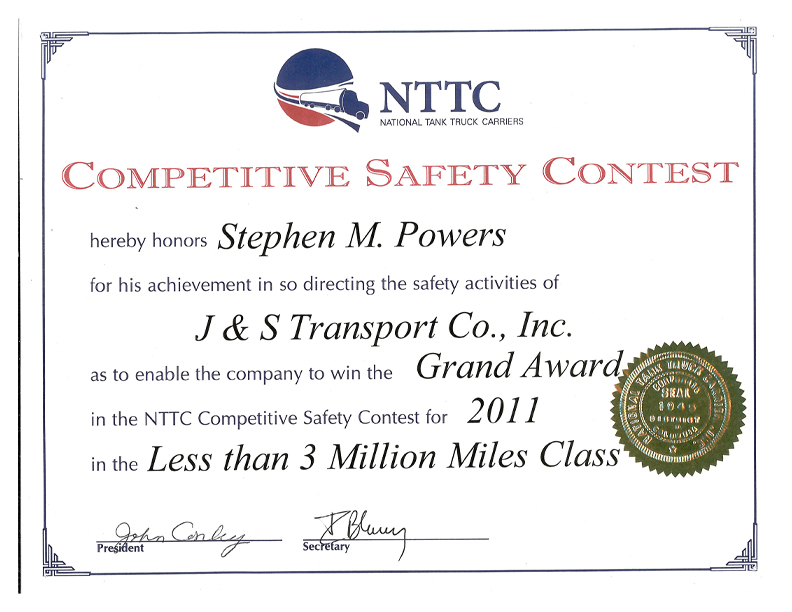

NTTC Competitive Safety Award
Thursday, July 19th, 20123rd Consecutive Grand Safety Award
Thursday, July 19th, 2012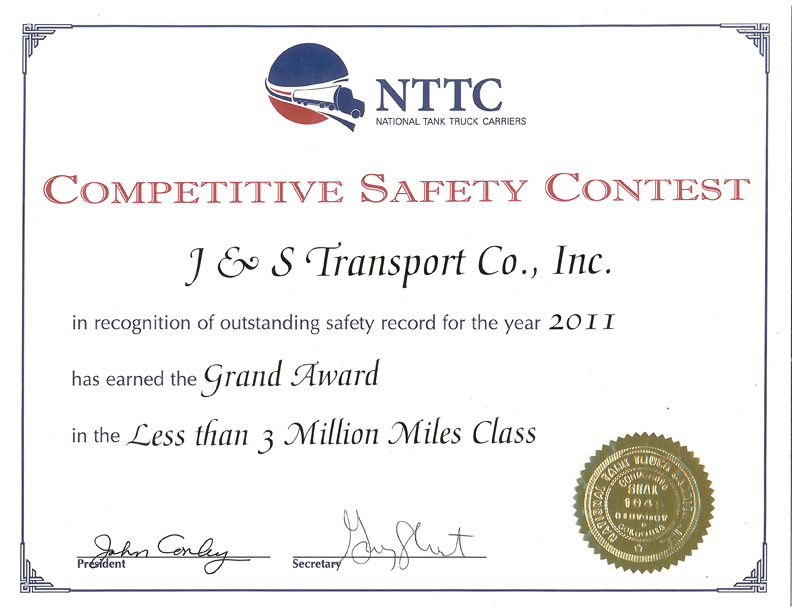
NTTC AWARD 2nd Year in a row
Friday, May 20th, 2011
2009 Safety Award Winner
2010 Safety Award Winner
.
J & S Transport Co., Inc., once again, and for the second year in a row, has been bestowed the National Tank Truck Carrier’s (NTTC) Grand Award for 2010 for the following categories:
– Competitive Safety Contest Grand Award in the Less than 3 Million Miles Class.
– Safety Director Award Competitive Safety Contest
– Safety Improvement Grand Award
The Safety Director award was presented at the NTTC Safety Conference in Austin, TX on April 7, 2011.
The company will be presented awards at the NTTC Annual Conference in Baltimore, MD on May 25, 2011.
The continued mission and success in keeping our staff, drivers and the public safe is our primary goal. The prestigious awards provided by the NTTC, is a pleasant reminder that our strong efforts to assure safety not only continue to work but, improve our safety record each year.

NTTC Awards
Tuesday, June 29th, 2010
NTTC Awards


Video
Tuesday, June 29th, 2010
Video
Michelin X ONE TIRE
Friday, August 7th, 2009

March 5, 2009
Fred Quinn
Territory Manager
Michelin Commercial Sales
Michelin North America, Inc.
126 Lunns Way/ Plymouth, MA 02360
Dear Mr. Quinn,
J & S Transport was formed in 1992 in Lynn, MA. As founding owners I and my wife Sharon Hamel still operate successfully today. The company, when formed, was made up of one tractor and leased trailer. The driving team was made up of two drivers consisting of another driver and myself. The truck was worked around the clock to provide the most economic benefit. The company has now been built to a fleet of six tractors and seven trailers. Sharon and I continue to maintain the company stability and success at the helm providing the direction and guidance to orchestrate the day-to-day activities of running the company.
The operational expenses are closely monitored and tires are a significant cost. J & S Transport had been using the dual tire configuration from 1992-2005 with success. Various tire companies were tried from 1992-2000 in an effort to improve the companies operating economics by enhancing the performance of the tires from a mileage/longevity standpoint. In 2000 we made a decision to use 100% Michelin tires.
In 2005 the X ONE XTE 455/55 22.5 (trailer tire) and X ONE XDAHT 455/55 22.5 (drive tire) had been tested on one of the fleet tractor-trailers. The tire was selected based on historical data provided by Michelin that demonstrated that the X ONE would provide a superior stability, fuel economy and would be lighter as to be able to haul >1.2% more product.
After testing the X ONE tires the initial results demonstrated that the X ONE could not withstand the weight and torque applied from the load of fuel (99,900 lbs). Evidence illustrated that the X ONE would peel and tear apart prematurely.
In communicating these results to Michelin it was also explained to J & S Transport that similar results were being experienced in various other applications that would apply similar stress on the X ONE tire.
In working with Michelin over the next two/three years a multitude of chemical compositions for the X ONE tire were developed and tested. Each iteration of the X ONE tire demonstrated enhanced mileage performance starting from approximately 70,000 miles of life on the original X ONE to the current 125,000 miles of life experienced today using the X ONE XDAHT (drive tire) and the X ONE XTE (trailer tire).
The savings realized in using the X ONE tire were three fold. The first was the savings associated with having to change the tires less frequently which resulted in a 9% annual savings for replacement tires. Secondly was the additional revenue realized due too the reduction in tire weight providing J & S Transport and opportunity to haul 1.2% more product resulting in additional revenue. Lastly a 17% increase in miles/gallon was recognized after switching to the X ONE.
In addition to the savings realized by the X ONE a safety concern was also addressed by the development of the X ONE XDN2. J & S Transport had concerns about the inclement weather performance of the X ONE historically (data provided by J & S Transport drivers) being identified as not providing sufficient traction as compared to a dual tire configuration. As a result of this concern Michelin focused specifically on the tread design in developing the X ONE XDN2. Since using the X ONE XDN2 tires the J & S Transport drivers have reported that the X ONE tires are providing significantly improved traction in snow conditions.
In closing it has been an extremely positive experience in working with Michelin and in particular using the X ONE tire. As noted in the aforementioned statements that even during unsuccessful trials Michelin stood by J & S Transport, utilizing their expertise and technical support, to provide an expedient cost effective solution. J & S Transport looks forward to a long working relationship with Michelin.
Sincerely,
John Hamel
President
J & S Transport
12 R Washington Street
Lynn, MA 01904-3306
Office: 781-599-6660
Fax: 781-596-8239
Boston HazMat Routing
Friday, August 7th, 2009
Fuel Transportation Quandary
Boston Hazardous Material Routing
“Catch-22”
Position Paper
October 8, 2008
Docket No. FMCSA-2008-0204
Written by: John Hamel, President, J&S Transport Co., Inc
12 R Washington Street
Lynn, MA 01904
prelude
For years it has been perplexing for fuel transporters to safely and legally navigate the roads in and around the City of Boston, Massachusetts. This bewilderment is attributed to many factors including the roadways constantly changing because of years of endless construction i.e. The Big Dig Central Artery Tunnel Project. However, to complicate and compound the issue, the Boston hazardous material transportation rules and routes to pass through the City of Boston are complex.
The complexity of interpreting the transportation rules is due primarily to the conflicting rules and positions established and maintained by the Federal Government 49 CFR 397, State Government – The Massachusetts Department of Highways (MassHighway), local enforcement (Boston City Police) and the Mass Turnpike Authority on what proper permitting is required and what route should be driven to meet the guidelines established to safely get in and around the City to make deliveries. The later providing the most confusion and pain.
When considering the transportation of hazardous materials, unequivocally the issue of safety requires first consideration, in particular when establishing a hazardous material route through a major City like Boston. The question then becomes what other factors are also considered i.e. How is this safety route established? Who is involved? What is the process for approval? Who makes the final decision? Lastly, how is the transportation route regulation communicated to the commercial companies and drivers?
Due diligence is a necessity by the regulatory agencies when considering a hazardous cargo transportation route to assure all interested parties have a say in the final decision. In the case of transporting hazardous material through the City of Boston it is the City of Boston that has to perform due diligence to assure that all parties have had an opportunity to express their issues and concerns? It is realized and obvious that even if all parties are invited to express their concerns not all will be in agreement to the final solution. Ah, democracy!
The intent of this paper is to provide and enlighten hauling companies and individuals responsible for transportation of hazardous material (fuel) on the various intricacies on hauling fuel in and around the City of Boston. The paper is also designed to spark questions on the regulation process and their practices, the person or persons making the final decisions, how those final decisions are communicated to the public and more importantly the transporters and their drivers to assure they understand the proper transporting route and are adhering strictly to all the regulations.
It is not the intent of this paper to criticize any particular state or federal office. Their job is complex and it is clearly understood that their decisions, with respect to routing hazardous material transporters, are difficult.
This paper may include some inaccurate information contingent upon opinion, source or timing. The reader should confirm any and all information provided in this paper.
Synopsis
J&S Transport based in Lynn, Massachusetts, and founded in 1992 by John and Sharon Hamel, provides fuel transport delivery services for many companies that include both major oil companies as well as many independent service stations. The company has been transporting fuel in and around the City of Boston, Massachusetts since its founding. Prior to J&S John had been delivering fuel in and around Boston since 1982.
Over the years the City of Boston had virtually no enforcement of said Hazmat Route.
From I-93South all Hazmat vehicles exited at High Street which today no longer exists. The only posting for a designated route was at that exit, once off the interstate the drivers were not directed along a posted route. Unless a driver was familiar with the city streets he was on his own. I have personally delivered to or driven through the city countless times and not once had an incident, or been aware of any serious incident. At times the Boston Fire Department would be located at the bottom of the High Street exit only checking to see if vehicles were loaded during the curfew hours 7-9AM and 4-6PM. If a vehicle was empty or had #2 fuel, or diesel fuel on board he was allowed to proceed. Not once was I asked to see a copy of a permit.
Over the last few years the difficulty of navigating in and around Boston has steadily increased. The Boston City Police Special Operations Unit had been assigned to stop hazardous material carriers and determine if their deliveries are for directly inside the City limits. If the transporter/driver could not provide the appropriate paperwork showing that they were making a delivery in Boston they were given a fine of $500-$1,000. Up until 2006 the City of Boston would allow through traffic to areas just south of the city.
Today the permitting process has become very lengthy and time consuming, once issued a permit it is only good for deliveries within the city limits except during curfew hours when no vehicles are allowed regardless of whether they are empty, loaded or type of product on board. The permit is needed between the hours of 6AM and 8PM Monday thru Friday weekends and Holidays are excluded.
Unfortunately the Boston Police Special Operations Unit has been directed to stop and ticket all HazMat vehicles regardless of time of day or day of week. The citations, at least all citations written to J&S or J&S drivers, have been for violation of Federal Code 397.67(b) which states that vehicles shall operate over routes that do not go through or near heavily populated areas, places where crowds are assembled, tunnels, narrow streets, or alleys, except where the motor carrier determines that: (b) (1) There is no practical alternative.
The problem I find with that is 397.67(b) states that a motor carrier carrying hazardous materials required to be placarded in accordance with 49CFR 177.823 and not subject to NRHM routing designations shall operate over routes that do not go through or near heavily populated areas, places where crowds are assembled, tunnels, narrow streets, or alleys, except where the motor carrier determines that: (b) (1) There is no practical alternative. We are subject to NRHM routing designations filed by the Mass Highway Department.
J&S has taken the issue to court on appeal and was found not responsible for five tickets issued to both the company and drivers.
The question now becomes why the Boston City Police Special Operations Unit continues to issue fines when clearly they are not in accordance with the established regulations?
The first reason of course is safety, although one must ask is it safer to travel the 4 miles through Boston or is it safer to travel 56 miles around the city taking you through many other cities and towns creating added exposure and risk and possible driver fatigue. Or could it be Boston just does not want any trucks traveling through the city.
Boston has argued that the route has not changed over the years when it clearly has, the only similarity between the old and new routes is the last mile from Congress Street and the Surface Road to the point where it rejoins I-93. The permitting process has also changed, the documents required to be submitted, the time between submitting an application and receiving a permit, the refusal to issue through traffic permits and not following their stated permitting times 6AM thru 8PM.
Conclusion
In Boston there is a clearly marked route for fuel tankers to travel safely through the City. For years hazardous material carriers have been utilizing the designated route, even when the route is detoured during construction, without any major incident.
The cost of trucking around the City is exorbitant and with rising fuel costs, increased labor costs, reduced productivity and so many other issues arising from Boston’s refusal in my opinion to follow the required process and procedures before enforcing a HazMat Ban is forcing trucking firms to reconsider their position in the market place. This could result in business failure leading to additional unemployment which the state can ill afford, an increase in the cost of gasoline and fuel to the citizens of the affected cities and towns to the south of the city. The transportation costs will eventually have to reflect the true mileage to those communities, and finally the possibility of outages to those communities.
Multiple people who are affected by not allowing fuel transport to travel through the City have not been consulted i.e. trucking companies, businesses, the general public and surrounding towns to include elected officials, first responders and other emergency personnel.
The federal government and MassHighway have made every effort to correct this issue and will need additional support going forward to make access for shipping hazardous material through the City a reality.
J&S Transport will continue to challenge the City of Boston hazardous material trucking route until a consistent and amicable option is provided. J&S Transport will also continue to assist other hazardous material transporters and trucking associations to continue to clarify options available to the industry.
Questions are welcome by contacting:
John Hamel – President
J&S Transport
If you would like to join our mailing list please enter your email address: