2013 Q4 “THE INSIDER” QUARTERLY REPORT

Thursday, October 10th, 2013

“THE INSIDER”
QUARTERLY REPORT

It’s Fall!

Another Summer season has ended and we now prepare for a beautiful Fall season in New England. Fall means school children, school buses, and additional traffic on the roadways. The professional drivers of J & S Transport need to take extra caution when sharing the road to protect our country’s most precious commodity; our children.

Company News

After much anticipation, J & S Transport has moved into the new corporate office. We can all agree how professional the new building looks. We ask that all employees do their part to keep there work areas clean and bright. Once the expansion of the yard is complete, we will eliminate the need to back across Washington Street into the yard.

We want to welcome our newest professionals to the Team! Driver Matthew Kutcheid and Evening Dispatcher Christian Salinder. Matt comes to us with many years in the petroleum transportation industry. Christian is a Licensed Coast Guard 3rd Mate having vast experience with ocean going tankers (Oilers) and transfering cargo from ship to shore. We look forward to having both Matt and Christian on our Team!

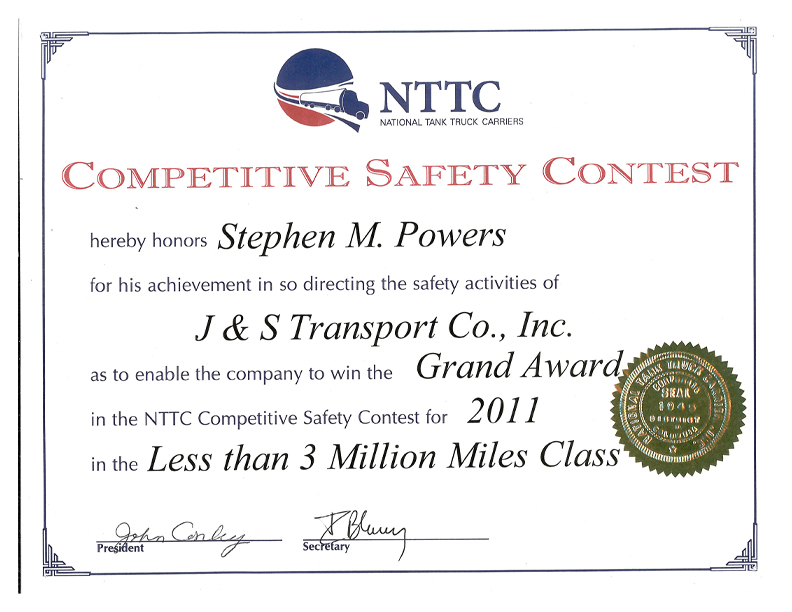
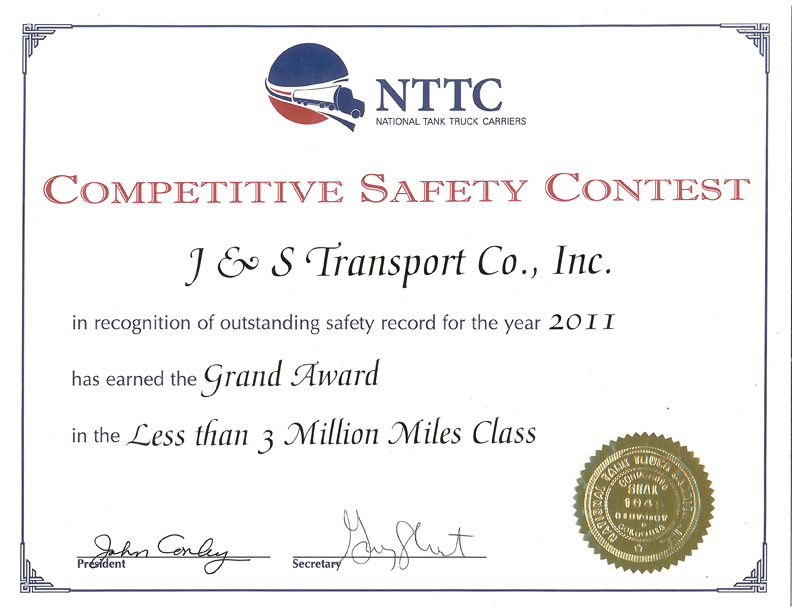
In addition to overseeing the construction work and the daily affairs of his and Sharon’s company, John Hamel has been quite involved with MA Motor Transport Association. John is a member of the Executive Committee and serves as First Chair. He is also Chairman of the Legislative Committee. John was heavily involved in the updating of the Association’s by-laws. Safety Steve was made Chairman of the MA State Truck Driving Championship Committee for 2014. In addition, Steve was nominated and elected as the Eastern Region Chairman for the National Tank Truck Carrier Safety and Security Council for 2014. J & S Transport is now becoming a major player in the Transportation Industry; both locally and nationally.

Sharing the Road Safely with School Children & School Buses

The National Safety Council states school buses are one of the safest forms of transportation on the road. This claim is substantiated by the findings from the National Highway Traffic Administration showing riding a bus to school is 13 times safer than riding in a passenger vehicle and 10 times safer than walking to school. The sad fact is children are hurt outside the bus than inside as passengers. Most of the children who lose their lives in bus related crashes are pedestrians, 4 to 7 years old, being hit by motorists illegally passing stopped school buses. Here are some safe driving tips to consider:

• Do not block the crosswalk when stopped at a red light or waiting to make a turn. Blocking the crosswalk forces school children to go around your vehicle, putting them in a dangerous situation.
• In posted school zones, you must stop to yield the right-of-way to children crossing the roadway within a marked or unmarked crosswalk
• Always stop when directed to do so by Safety Patrol Officer or Crossing Guard.
• Children are the least predictable and most difficult to see. They are very comfortable with their surroundings making them more likely to take risks, ignoring hazards or failing to look both ways when crossing the street. Take extra care to look out for children in school zones, residential areas, playgrounds and parks.
• It is illegal to pass a school bus stopped to load and unload children in all 50 States.
• School buses use yellow flashing lights to alert motorists they are preparing to stop to load or unload children. Red flashing lights signals the motorist the bus is stopped with children getting on or off the bus.
• All 50 States require traffic in both directions stop on undivided roadways when children are entering or exiting a school bus.
• The area 10’ around a school bus is where children are in the most danger of being hit. Stop your vehicle far enough from the bus to create the space for children to safely enter or exit the bus.
• Never, ever pass a school bus on the right. It is illegal and could have tragic results.

How About Sharing the Road with Bicyclists?

How many times have you driven on winding roads and come up on bicyclists heading the same direction you are. In order to pass these bicyclists you may need to cross a double solid line, risking a head-on collision with a vehicle headed in the opposite direction. Or you may pass too close sideswiping the rider, knocking them off the bike. On most roadways, bicyclists have the same rights and responsibilities as other vehicles but bicycles are harder to see with the riders exposed and easily injured in a collision. This is especially true with children riding bicycles because they do not have the experience and not capable of proper judgement when riding in traffic. The National Safety Council recommends the following:

• When passing a bicyclist heading in the same direction, slow down and leave at least a distance of 3 feet between your vehicle and the bicyclist. Maintain this clearance until safely passing the bicycle. If you are traveling on a narrow, winding road, do not attempt to pass until you can clearly see vehicles approaching you in the opposing lane. Pass the bicyclist only when safe to do so.
• The most common cause of collisions are drivers turning left in front of an oncoming bicycle, cutting across the bicyclist’s path.
• When you are making a left hand turn and there is a bicyclist entering the intersection from the opposite direction, let the bicycle pass before making the turn.
• When you are making a right turn and the bicyclist is approaching on the right, let the bicycle go through the intersection prior to making your turn ensuring you use your turn signals.
• Watch for riders turning in front of you without looking or signaling, especially if the bike rider is a child.
• Take extra peecautions in school zones and neighborhoods where children may be riding.
• Watch out for bikes coming out of driveways, parked cars or other blind spots.
• Check side view mirrors for approaching bicyclists before opening the door to your vehicle. You do not want a collision caused by opening a door in the path of the bicyclist.

Healthy Choices

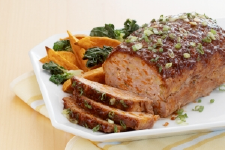
The Fall season means football and football means assuming the position of a couch potato; suffering carpel tunnel syndrome from over using the TV remote. One of our health conscience drivers (?) requested a healthy meatloaf recipe to fix and chow down on while watching the game. Dr. Oz recommends this recipe from his website:
Ingredients
2 lbs ground turkey
1/2 cup whole wheat bread crumbs
1 egg, beaten
3 tsp olive oil
1 clove garlic, finely minced
1/2 onion, finely diced
1/2 red pepper, finely diced
1/2 green pepper, finely diced
1/4 cup frozen corn kernels
1/4 tbsp cumin
1/4 tbsp chili powder
1/4 tbsp cayenne pepper
1/4 cup of plain tomato sauce
1 tbsp chili in adobo sauce (from the can)
1 chili in adobo, finely diced (from the can)
Salt, pepper to taste

Topping:
1/2 cup salsa (non-chunky works best)
1 tsp chili in adobo sauce (from the can)
1/2 tbsp honey
Salt and pepper to taste

Directions
Preheat oven to 375° F. Lightly grease a large baking sheet with 1 tsp of oil. Heat 3 tsp of olive oil in a sauté pan and cook onion, garlic, red and green pepper over a medium flame until soft, for approximately 3 minutes. Turn off heat and remove pan from stove; allow to cool for 5 minutes.

In a large mixing bowl, add the ground turkey, egg, breadcrumbs, tomato sauce, chili, chili sauce, frozen corn, cumin, chili powder and cayenne pepper, salt and pepper. Mix well to combine all ingredients. In a small bowl, prepare the topping by stirring together all of the ingredients. Add the sautéed veggies to the turkey mixture and combine well.

Transfer the mixture onto the sheet pan and form into a rectangular loaf. Pour the glaze over the top and spread evenly. Place a sheet of aluminum foil loosely over the top of the meatloaf and place in the oven for 30 minutes. Remove the foil after 30 minutes and continue to cook for an additional 15 minutes. Remove from oven, slice and serve.

2013 Q3 Quarterly Report

Monday, July 8th, 2013

It’s Summer!

Wow! Summer’s here, schools out and vacation schedules full. We all need to make sure we are extra dilgent watching out for bike riders, motorcyclists and children playing. This newsletter includes articles providing summer health tips.. Also what would “The Insider” be without a healthy recipe?!

Company News

The new Corporate Office is just about finished and ready for occupation. We are extremely excited and pleased how the project has progressed., We will soon be expanding the yard by taking down the hillside. Once that is complete, we should have enough room for our units to turn around and will no longer back across Washington Street.

Safety Steve has been busy promoting safety while bringing J & S Transport to center stage as the leader in Safety for our Industry. He renewed his accreditation as a Certified Director of Safety (CDS) with the North American Transportation Management Institute.. Steve had to submit a portfolio to the Accreditation Board for review and approval. Safety Steve was elected Chairman of the National Tank Truck Carrier Association Safety and Security Council, East Region during a meeting in Denver, CO this past June. Steve was also made Chairman, Massachusetts Truck Driving Championship Committee for 2014.

Amanda Hamel graduated from Salem State University receiving her Bachelor of Science Degree in Business, with a concentration in Accounting. Amanda is now setting her sights on Graduate School.. Will we soon have an MBA’er in our midst?!

Summer brings fun but health risks as well

No doubt about it; Summer means breaking out the lawn mower to handle the lawn we worked so hard on over the Spring. Did you know that lawn mowers cause a significant amount of injury to users? The National Safety Council reports that more than 234,000 people received medical treatment for lawn mower related injuries in 2012. They polled the American Academy of Pediatrics, American Academy of Orthopaedic Surgeons and American Society for Reconstructive Microsurgery to identify precautions to help reduce the risk of injury. They are:

➢ Use a lawn mower with a control that stops the blade if the handle is released
➢ Remove stones, toys and other objects from the lawn before mowing to prevent injuries from flying objects
➢ Kids should be at least 12 years old before operating a push mower and 16 years old before operating a riding mower
➢ Wear polycarbonate protective eyewear while operating the mower
➢ Do not allow children as passengers on riding lawn mowers, and keep them out of the yard while mowing
➢ Drive up and down slopes, not across, to prevent mower rollover
➢ Use a stick or broom handle – not your hands – to clear debris from the mower

When you are outside mowing the lawn or doing yardwork, keep in mind that overexposure to the sun can damage the skin and could cause skin cancer. Heat stroke, heat exhaustion, heat cramps and heat rash are possible when you become overexerted in the heat. NSC recommends you:

➢ Wear a wide-brimmed hat to keep your head and face cool. This will also provide added protection from damaging sun exposure. Baseball caps provide little protection except to the face. A hat should protect the neck, face and ears
➢ Wear a long-sleeved shirt at all times. It should be light colored and loose fitting except when working around machinery
➢ Carry a source of water with you. Take drinks frequently – every 15 minutes
➢ Take frequent breaks in the shade or in a cool environment during the hottest times of the day
➢ Someone suffering from heat exhaustion or heat stroke should be moved to a cool environment., offered sips of water, if conscious, and provided with attention from emergency medical personnel
➢ Wear sunscreen that has an SPF of at least 15. Make sure children are also adequately protected.

Ibuprofen and Risk of Heart Attack
Researchers in Oxford, England have released a study showing high doses of ibuprofen or similar painkillers (non-steroidal anti inflammatory drugs) where a daily dose of 2,400 milligrams increased the risk of heart attack, stroke or death by one-third. This type of painkiller was also associated with double the risk of heart failure and a higher chance of gastrointestinal complications such as ulcers. These researchers noted that the risk was higher among people with underlying risk factors, such as elevated blood pressure or cholesterol. They suggest people talk with their primary care physicians before taking these medications.

Healthy Choices

Pasta with grilled chicken, white beans and mushrooms

Ingredients
o 2 boneless, skinless chicken breasts, each 4 ounces
o 1 tablespoon olive oil
o 1/2 cup chopped white onion
o 1 cup sliced mushrooms
o 1 cup white beans, cooked
o 2 tablespoons chopped garlic
o 1/4 cup chopped fresh basil
o 12 ounces uncooked rotelle pasta
o 1/4 cup Parmesan cheese
o Ground black pepper, to taste

Directions
Prepare a hot fire in a charcoal grill or heat a gas grill or broiler. Away from the heat source, lightly coat the grill rack or broiler pan with cooking spray. Position the cooking rack 4 to 6 inches from the heat source.
Grill or broil the chicken until browned and just cooked through, about 5 minutes each side. Transfer the chicken to a cutting board and let rest 5 minutes before slicing into strips.
In a large, nonstick frying pan, heat the olive oil over medium heat. Add the onions and mushrooms and saute until tender, about 5 minutes. Stir in the white beans, garlic, basil and grilled chicken strips. Keep warm.
Fill a large pot 3/4 full with water and bring to a boil. Add the pasta and cook until al dente (tender), 10 to 12 minutes, or according to the package directions. Drain the pasta thoroughly.
Return the pasta to the pot and add the chicken mixture. Toss to mix evenly.
Divide the pasta among the plates. Garnish each with 1 tablespoon Parmesan cheese and black pepper. Serve immediately.
Nutritional analysis per serving
Calories 408 Sodium 122 mg
Total fat 7 g Total carbohydrate 58 g
Saturated fat 2 g Dietary fiber 5 g
Monounsaturated fat 3 g Protein 28 g
Cholesterol 37 mg

2nd Qtr Newsletter 2013

Tuesday, April 2nd, 2013

A New Season

J & S Transport has endured yet another winter with cold winds, snow and ice. As we say good bye to Old Man Winter, we welcome the seed catalogs in the mail, the garden centers at the box stores and our hopes for abundant gardens. During this time of rejuvenation, we give thanks to J & S Transport, Co., Inc. for providing us the means to support our families with the company asking in return we renew our commitment to drive safely and work injury free.

Company News

EOBDR’s – J & S Transport has started testing Electronic Onboard Data Recorders to outfit the fleet. The first unit to be tested was from Rand McNally and was installed in T19 to see how it would perform. We are now going to test a unit from Reltima. Our current GPS program is a Reltima product and we look forward to see how both systems interface, especially with our Dispatch system provided by Creative Energies. We will be using these units to replace the paper Hours-of-Service logs. It will take a little time getting used to this new program however, it appears that EOBDR’s will soon be mandated by the FMCSA so we need to get ready. We will continue using paper logs along with the paperless logs until everyone is comfortable with it. The other benefit of EOBDR’s to effectively manage the efficiency of our vehicles. With today’s high fuel costs, we need to ensure each vehicle is operated efficiently and in a productive manner.

Hours-of-Service – Come July 1 of this year, there will be changes to the Hours-of-Service Regulations. In a nutshell, the Federal Motor Carrier Safety Administration will reduce the 34 Hour Reset to once per week. This Regulation will also require providing the driver 2 periods between the hours of 0100-0500 at their domicile. Also, drivers will only be able to drive if 8 hours have passed since the end of the driver’s last off-duty period of at least 30 minutes. We will be having meetings to ensure everyone understands these new changes prior to July 1.

The new Corporate Office is progressing nicely. In addition to a Drivers’ Room, there will be a conference room and separate Dispatch Office. We should be able to move in early this summer.

Warmer Weather Means Trading Snowmobiles for Motorcycles

What is the best way to chase away those winter blues? Waking up the motorcycle from its long winters nap, firing it up to again to feel the wind in your face; of course! Nothing better than heading north to New Hampshire, pulling into the Welcome Center to take the helmet off while thumbing your nose at the Massachusetts Helmet Law. You have to appreciate the State allowing personal freedoms however this is the same state having State liquor stores located at motorist Safety Rest Areas!

The Centers of Disease Control and Prevention states that preventing serious injuries and deaths from motorcycle crashes is a major and growing public concern.

Please consider:

  • Motorcycle crashes killed 4,502 people in 2010
  • Motorcycle-related deaths have increased by 55% since 2000
  • Motorcycle crash-related injuries and deaths totaled $12 Billion in one year, in medical costs and productivity losses


The good news is that riders, and their passengers, can protect themselves by wearing helmets. Helmets are estimated to prevent 37% of crash deaths among motorcycle riders and 41% of crash deaths for motorcycle passengers. The CDC offers the following motorcycle safety tips:

~ Always wear a DOT approved helmet

~  Never ride your motorcycle after drinking alcohol

~  Don’t let friends drive impaired

~  Wear protective clothing that provides some level of injury protection

~  Avoid tailgating

~ Maintain a safe speed and exercise caution when traveling over slippery surfaces or gravel

Yard and Garden Clean-Ups

When the first crocus or daffodil pokes up through the soil, the blood gets running to put on the garden gloves to start cleaning up the yard and garden. It would be best to keep in mind that beside spring blooms waking up, so aren’t snakes, insects and poisonous plants. Physical contact with these species can result in a visit to the emergency room. Exposure may cause an allergic reaction that is mildly uncomfortable or debilitating pain requiring immediate medical attention. The three concerns you should have while doing yard work are:

Snakes – New England claims 2 venomous snakes; the Timber Rattlesnake and the Northern Copperhead.

Insects – Bees, Wasps and Ticks

Plants – Poison Ivy; Ingesting Lily-of-the-Valley, Buttercups, White Baneberry, Celandine and Purple Nightshade

To prevent exposure and possible allergic reactions from these gifts of nature:

~Wear protective clothing

~Don’t burn poisonous plants – can cause respiratory problems

~Keep your eyes open, look where you’re stepping, notice large numbers of bees and wasps which indicate hives nearby, avoid coming in contact with Poison Ivy

~ If cooking wild greens, know what they are and where they came from

~Wash hands, clothes and equipment after each use

~Use repellents and check yourself closely for ticks


Healthy Choices

Asparagus is a healthy spring vegetable and quite available at farm stands and grocery stores. When combined with tilapia, it makes for a tasty and healthy meal celebrating the spring season!


Chili-Rubbed Tilapia with Asparagus & Lemon

Tilapia, a relatively plentiful fish, has the unfortunate reputation of being dull. All it needs is a spice rub, a familiar barbecuing technique that works just as well indoors. You could also use this rub on chicken breasts or toss it with lightly oiled shrimp before cooking.

4 servings

Active Time: 20 minutes

Total Time: 20 minutes

Ingredients

  • 2 pounds asparagus, tough ends trimmed, cut into 1-inch pieces
  • 2 tablespoons chili powder
  • 1/2 teaspoon garlic, powder
  • 1/2 teaspoon salt, divided
  • 1 pound tilapia, Pacific sole or other firm white fish fillets
  • 2 tablespoons extra-virgin olive oil
  • 3 tablespoons lemon juice

Preparation

  1. Bring 1 inch of water to a boil in a large saucepan. Put asparagus in a steamer basket, place in the pan, cover and steam until tender-crisp, about 4 minutes. Transfer to a large plate, spreading out to cool.
  2. Combine chili powder, garlic powder and 1/4 teaspoon salt on a plate. Dredge fillets in the spice mixture to coat. Heat oil in a large nonstick skillet over medium-high heat. Add the fish and cook until just opaque in the center, gently turning halfway, 5 to 7 minutes total. Divide among 4 plates. Immediately add lemon juice, the remaining 1/4 teaspoon salt and asparagus to the pan and cook, stirring constantly, until the asparagus is coated and heated through, about 2 minutes. Serve the asparagus with the fish.

Nutrition

Per serving: 211 calories; 10 g fat ( 2 g sat , 6 g mono ); 57 mg cholesterol; 8 g carbohydrates; 0 g added sugars; 26 g protein; 4 g fiber; 419 mg sodium; 681 mg potassium.

Nutrition Bonus: Vitamin C (37% daily value), Folate (33% dv), Iron (33% dv), Fiber (24% dv).

Carbohydrate Servings: 1/2


Agricultural Products as WMD’s

Tuesday, February 5th, 2013

Date: 02/01/2012

Dear Professional Driver,

Most of you or your folks probably remember back in the 70’s when C.W. McCall released his song titled “Convoy”?  Most truckers knew the chorus by heart:

“‘Cause we got a little ol’ convoy rockin’ through the night. Yeah, we got a little ol’ convoy, ain’t she a beautiful sight? Come on and join our convoy ain’t nothin’ gonna get in our way. We gonna roll this truckin’ convoy cross the U-S-A.”

The definition of a convoy is when a group of motor vehicles, ships or aircraft travel together for mutual support and protection. This made a lot of sense for the Merchant Marines during WWII in U-Boat infested waters and B-17’s during daylight bombing missions over Europe. Trucking convoys came into being with the fuel crisis in the seventies when speed limits were reduced to 55 mph. Many truck drivers were finding it too difficult to keep delivery schedules maintaining that speed and became prime targets for speed traps. Convoys were started so multiple trucks could run together a high rate of speed believing that if they did pass a speed trap, the police would only able to pick off one of them. It was also believed that close “drafting” (a la NASCAR) would conserve precious fuel.

Okay, back to the 21st century. How many times have you witnessed several commercial motor vehicles linked together and, at times, belonging to the same motor carrier? Does the professional truck driver need to convoy? Sure, a line of commercial motor vehicles traveling down the highway does make for an impressive site, provides great revenue for charity events and lives up to the stereotype of the 1970’s truck driver. But, is it a safe and professional practice? If you ask any law enforcement official, a convoy not sanctioned by the authorities or under escort; is illegal. Why?

  • Convoys impede traffic flow
  • Convoys create havoc for anyone trying to enter or exit the interstate
  • Convoys invite tailgating which reduces stopping reaction time
  • Conveys impedes the CMV driver’s ability to get the big picture by not being able to look ahead of the vehicle in front of them
  • Out of the three (3) evasive driving maneuvers, left, right, or stop; a convoy eliminates the stopping maneuver when tailgating is involved.

We can all agree that the above issues are all safety related and viable causes for CMV accidents. The one area not mentioned and needs to be addressed is the exposure to that motor carrier’s liability. To illustrate this exposure, consider a motor carrier with a fleet of 4 transport vehicles. Two (2) vehicles are convoying together, drafting and tailgating. A sudden accident occurs ahead of the lead vehicle, involving it with the 2nd unit following suit. That motor carrier just lost 50% of its vehicle assets. Bodily injury and physical damage claims are now doubled and the quality of life for those 2 drivers and their families may never be the same again.

There is never a need for two (2) or more J & S Transport vehicles to travel together, even with providing initial delivery to new stations, replenishing bulk-plants or assisting with pump-outs. If the work order does entail 2 or more vehicles, each vehicle must maintain, as a minimum, a one (1) mile separation from each other.

Let’s protect J & S Transport’s liability while safeguarding our livelihoods. Resist the urge to hook up with other vehicles, especially when one is another J & S Transport unit.

Be Safe!!

Steve

2013 Q1 Quarterly Report

Friday, January 4th, 2013

A New Year with a New Year’s Resolution


A very eventful year for J & S Transport has come to a close with the hope 2013 brings improvement to our economy allowing stronger growth and prosperity for us all. We must strive for 2013 to be accident and injury free. This is the resolution J & S Transport shall make for the New Year. If we control the cost of these involvements, our insurance ratings will improve allowing additional operating revenue.

Company News

Please join us in welcoming our 2 new drivers; Jim Braid and Mike Atwood. Jim Braid is well known in our industry and Mike Atwood brings extensive experience and knowledge as a delivery driver. Please introduce yourselves to Jim and Mike, welcoming them to the team.

Have you noticed the construction going on around the property? Since Artic Oil sustained the fire to their facility, they opted to purchase the property and building once owned by Rossi Memorials. They will operate Artic Oil and Ferrari Landscape from that new location. John and Sharon Hamel have agreed to lease the old location, renovate the damaged building, moving the corporate office into the new and improved facility. This will increase the yard area for our equipment with future expansion possibilities.

Mark your calendars with the date of our Annual Meeting. We will again be holding our meeting at the Boston Marriott Peabody, MA on March 2, 2013. We will be providing more information as we finalize the details.

J & S Transport took part in the Danvers, MA Truck Show this past fall. Don Wood entered our unit into the show ensuring the unit was detailed bumper to bumper. Our unit proved to be a big hit with Donnie being a tour guide, explaining the role of a petroleum tanker while letting kids sit in the driver’s seat and blow the air horn. In this picture, Don is with his beautiful wife Lori and their children, little Donald and Benjamin who appear to have had enough of that air horn!

DOT Regulatory Changes for 2013

2013 brings Hours of Service (HOS) Final Ruling compliance for Motor Carriers and CDL holders operating Commercial Motor Vehicles if:

  • The CMV weighs 10,001 pounds or more
  • Has a gross vehicle weight rating or gross combination weight rating of 10,001 pounds or more
  • A vehicle that is involved in interstate or intrastate commerce and is transporting hazardous material in a quantity requiring placards is also considered a CMV


On July 1, 2013 the limitations of minimum 34-hour hour restarts and rest breaks become effective. Specifically:


  • The 34 hour restart may be only used once per week
  • The 34 hour restart must include two periods between 1:00 a.m. – 5:00 a.m. home terminal time
  • The driver may only drive if 8 hours or less have passed since end of driver’s last off-duty period of at least 30 minutes. [HM 397.5 mandatory “in attendance” time may be included in break if no other duties performed]


Employees will be receiving more detailed information as the compliance date nears.

DOT Drug Testing & Marijuana

I am quite sure you are aware that the Commonwealth of Massachusetts has legalized Medical Marijuana with Colorado and Washington legalizing recreational usage. Before any CDL holder thinks they can torch a blunt while mellowing on the “Jimi Hendrix Experience”; better reconsider this action.


The Department of Transportation makes it perfectly clear that State guidelines on Marijuana usage will have no bearing on the FMCSA’s Drug Testing Program. The DOT’s Drug and Alcohol Testing Regulation – 49CFR Part 40.151(e) does not authorize any marijuana usage under state law to be a valid medical explanation for a positive drug test result.

How to Make an Effective 911 Call

When faced with a life threatening emergency, we all know to call 911. However, the National Safety Council explains that some people might not know how to make an effective 911 call and how to avoid issues that can arise when calling from a cell phone.

In an emergency situation, a caller might experience a wide range of emotions which could interfere with their ability to communicate clearly. Knowing ahead of time what information the 911 Dispatcher will ask for preventing extended response times.


Making an effective 911 call requires knowledge about how your cell phone will work in certain locations. Cell phone users need to realize that cell phone calls may not be traced. Tracing a cell phone relies on the triangulation of wireless signals. Many “smart phones” have GPS apps that assist in the location of the device but users need to understand the limitations of the cell phone they have. Case in point, if a 911 emergency call is made with a cell phone inside a building, locating the caller’s wireless signal becomes difficult. Emergency experts advise cell phone callers to quickly advise 911 Dispatchers their exact address, including floor and apartment numbers.


The National Safety Council advises to only make a 911 call when immediate response is needed for a vehicle accident, fire, serious illness, injury or crime. Stay calm and tell the Dispatcher your name, location, phone number and nature of the emergency. Do not assume the Dispatcher will be able to track your location, and by all means, do not hang up on the Dispatcher. Every call must be taken seriously, so a Dispatcher will redial the number of the caller to ascertain the true nature of the call. Stay on the line and follow directions. Do not end the call until the Dispatcher tells you to hand up. Under no circumstance is the 911 System to be used for non-emergencies.

Healthy Choices


Now that we are in the cold grip of winter, we need to revisit hypothermia and the effect it has on your body. Hypothermia sets in when your body temperature drops below 95.0 degrees F. The signs and symptoms of hypothermia depend on one of three states of severity:


  • Mild – shivering, elevated blood pressure
  • Moderate – violent shivering, muscle mis-coordination (stumbling, slow and labored movement), skid becomes pale with lips, ears, fingers and toes may become blue
  • Severe – Difficulty, sluggish thinking, amnesia, inability to use hands, walking becomes near impossible with behavior becoming irrational/incoherent with major organs failing; resulting in death


Prevention is the key to combat hypothermia. The selection of appropriate clothing is paramount. Synthetic and wool fabrics are superior to cotton as they provide better insulation when wet or dry. Some synthetic fabrics, such as polypropylene and polyester, are used in clothing designed to wick perspiration away from the body, such as liner socks and moisture–wicking undergarments. If the Saint Bernard comes by with a keg of brandy; shoo him away. Alcohol consumption increases the risk of hypothermia by dilating blood vessels which increase blood flow, making you feel warm while increasing heat loss to vital organs.

How about a quick healthy dinner recipe to warm up the family on a cold winter’s evening? How about messy, lip smacking, napkin wasting Sloppy Joes? You may want to use 96% lean ground beef or ground turkey breast.

Healthy Sloppy Joes  

Ingredients

  • 1 pound extra-lean ground beef
  • 1 onion, diced
  • 4 cloves garlic, minced
  • 1 jalapeno, minced
  • 1 red pepper, diced
  • 1 can small red beans or pinto beans, preferably low sodium drained and rinsed
  • 1 1/2 cups no-salt-added tomato sauce
  • 2 tablespoons tomato paste
  • 1 tablespoon red wine vinegar
  • 1 tablespoon molasses
  • 1 tablespoon Worcestershire sauce
  • 1 teaspoon mustard powder
  • 3/4 teaspoon salt
  • Freshly ground black pepper
  • 8 whole-wheat burger buns


Directions

Brown the meat and the onion in a large nonstick skillet over medium-high heat for 5 minutes, breaking up the meat into crumbles as it cooks. Pour the drippings out of the pan and discard. Add the garlic, jalapeno, and red pepper and cook 5 minutes more, stirring occasionally. Stir in the rest of the ingredients, reduce heat to low, and simmer for 5 minutes more. Place a half-cup scoop of the mixture onto each bun and serve.

JandS Drivers Letter CVSA

Thursday, November 1st, 2012

Dear Professional Driver,

When you get pulled over for a roadside inspection, did you ever realize the cast of characters behind the inspection of your unit? A State Trooper performs the inspection required by the Federal Motor Carrier Safety Administration, under the authority of the Department of Transportation. If the vehicle receives no violations, a decal is affixed to the transport vehicle with the acronym “CVSA” printed on that decal. You may now question; why CVSA and not one with the DOT, FMCSA or State insignia printed on it? Who are these CVSA people and what is their relationship with the DOT, FMCSA, State Police and commercial motor vehicle safety?
Let there be no question the Department of Transportation has overall authority and responsibility for commercial motor vehicle safety. This authority is delegated to the Federal Motor Carrier Safety Administration for the issuance, administration and enforcement of commercial motor vehicle safety regulations. The FMCSA requests State Law Enforcement Authorities to assist with this enforcement responsibility by creating the Motor Carrier Safety Assistance Program (MCSAP). MCSAP is a Federal grant program providing financial assistance to State Governments for the enforcement of those regulations issued by the FMCSA.
Initially, States performed individual CMV safety inspections within their own borders having no “reciprocity” between other states. In other words, if the commercial motor vehicle was inspected in one State, the credit of receiving that inspection was not shared with other States. This created a situation where a CMV was inspected in one state and when crossing state lines, be subject to another inspection. Members of Federal and State Government, Motor Vehicle Carriers and Public Service Commission’s soon realized a system was needed to standardize inspection criteria with reciprocal credit being shared between States. This system would reduce redundancy in efforts, wasted government resources while allowing motor carriers to save on operating expenses.
The Federal Government developed a Memorandum of Understanding (MOU) to establish uniformity and reciprocity among state highway enforcement agencies to improve the safe operation of commercial motor vehicles. Out of this MOU, the Commercial Vehicle Safety Alliance (CVSA) was born. CVSA is an international, not-for-profit organization with representation from local, State, FMCSA officials, Foreign Ministries and industry representatives. This Alliance provides leadership to law enforcement personnel and policy makers. The goal of CVSA is the uniformity, compatibility and reciprocity for commercial motor vehicle inspections and enforcement activities throughout all North America. CVSA would provide standardized inspection and out-of-service criteria accepted by all enforcement agencies. This would not only provide consistency but have all States recognize each other’s road side inspections including the commercial motor vehicle, driver and cargo across State lines and National borders. CVSA then created their North American Standard Inspection Levels and Out-of-Service criteria. These Inspection Levels are:
Level I – North American Standard Inspection
Level II – Walk-Around Driver/Vehicle Inspection
Level III – Driver/Credential Inspection
Level IV – Special Inspection
Level V – Vehicle Only Inspection
Level VI – North American Standard Inspection for Transuranic Waste and Highway Route Controlled Quantities (HRCQ) of Radioactive Material Inspection
Level VII – Jurisdictional Mandated Commercial Vehicle Inspection
Now, when the professional driver pulls into a roadside inspection and receives the CVSA decal, he can be assured that the Roadside Inspector is certified to conduct that inspection, complying with all standardized inspection and out-of-service criteria. The inspection results are shared and accepted among all states traveled. The driver understands the primary focus of that inspection was to highway safety and security. This consistency is also to ensure fairness when a motor carrier receives their CSA safety scores.
Now you know the whole roadside inspection story!

Be Safe!

Steve
Dear Professional Driver,

When you get pulled over for a roadside inspection, did you ever realize the cast of characters behind the inspection of your unit? A State Trooper performs the inspection required by the Federal Motor Carrier Safety Administration, under the authority of the Department of Transportation. If the vehicle receives no violations, a decal is affixed to the transport vehicle with the acronym “CVSA” printed on that decal. You may now question; why CVSA and not one with the DOT, FMCSA or State insignia printed on it? Who are these CVSA people and what is their relationship with the DOT, FMCSA, State Police and commercial motor vehicle safety?
Let there be no question the Department of Transportation has overall authority and responsibility for commercial motor vehicle safety. This authority is delegated to the Federal Motor Carrier Safety Administration for the issuance, administration and enforcement of commercial motor vehicle safety regulations. The FMCSA requests State Law Enforcement Authorities to assist with this enforcement responsibility by creating the Motor Carrier Safety Assistance Program (MCSAP). MCSAP is a Federal grant program providing financial assistance to State Governments for the enforcement of those regulations issued by the FMCSA.
Initially, States performed individual CMV safety inspections within their own borders having no “reciprocity” between other states. In other words, if the commercial motor vehicle was inspected in one State, the credit of receiving that inspection was not shared with other States. This created a situation where a CMV was inspected in one state and when crossing state lines, be subject to another inspection. Members of Federal and State Government, Motor Vehicle Carriers and Public Service Commission’s soon realized a system was needed to standardize inspection criteria with reciprocal credit being shared between States. This system would reduce redundancy in efforts, wasted government resources while allowing motor carriers to save on operating expenses.
The Federal Government developed a Memorandum of Understanding (MOU) to establish uniformity and reciprocity among state highway enforcement agencies to improve the safe operation of commercial motor vehicles. Out of this MOU, the Commercial Vehicle Safety Alliance (CVSA) was born. CVSA is an international, not-for-profit organization with representation from local, State, FMCSA officials, Foreign Ministries and industry representatives. This Alliance provides leadership to law enforcement personnel and policy makers. The goal of CVSA is the uniformity, compatibility and reciprocity for commercial motor vehicle inspections and enforcement activities throughout all North America. CVSA would provide standardized inspection and out-of-service criteria accepted by all enforcement agencies. This would not only provide consistency but have all States recognize each other’s road side inspections including the commercial motor vehicle, driver and cargo across State lines and National borders. CVSA then created their North American Standard Inspection Levels and Out-of-Service criteria. These Inspection Levels are:
Level I – North American Standard Inspection
Level II – Walk-Around Driver/Vehicle Inspection
Level III – Driver/Credential Inspection
Level IV – Special Inspection
Level V – Vehicle Only Inspection
Level VI – North American Standard Inspection for Transuranic Waste and Highway Route Controlled Quantities (HRCQ) of Radioactive Material Inspection
Level VII – Jurisdictional Mandated Commercial Vehicle Inspection
Now, when the professional driver pulls into a roadside inspection and receives the CVSA decal, he can be assured that the Roadside Inspector is certified to conduct that inspection, complying with all standardized inspection and out-of-service criteria. The inspection results are shared and accepted among all states traveled. The driver understands the primary focus of that inspection was to highway safety and security. This consistency is also to ensure fairness when a motor carrier receives their CSA safety scores.
Now you know the whole roadside inspection story!

Be Safe!

Steve

“THE INSIDER” QUARTERLY REPORT

Friday, September 28th, 2012

Where Did the Summer Go?
It’s hard to believe that summer is over and schools have started another academic year. We all must focus our attention to increased commuter traffic on the roadways. Commuter traffic includes school children walking to school, waiting at school bus stops, stopped school buses and while traveling through school zones. Children are our most precious commodity, to be protected at all costs. Be diligent, aware of your surroundings by keeping your eyes moving. Have safe and enjoyable holidays!

Snow and Ice Are Coming – Is Your Car Ready?

With school back in session and finishing raking leaves; we must also turn our attention to Old Man Winter and be prepared for what he brings weather wise. The National Safety Council suggests the following checklist to prepare your car for winter:

• Checking the ignition, brakes, wiring, hoses and fan belts
• Changing and adjusting the spark plugs
• Checking the air, fuel and emission filters and PCV valve
• Inspecting the distributer or fuel injection system
• Checking the battery
• Checking the tires for air pressures, tire wear and tread depth
• Checking antifreeze level in the radiator
• Keeping large grit sand or kitty litter in your trunk to use when traction is needed
• Checking to see if the windshield wipers work and in good condition
• Headlights clean enough to allow proper visibility
• Checking the defroster, removing clutter from around the vents for better air flow
• Keeping more than a quarter tank of gas at all times
• Keeping flashlights, warm blankets readily available if you are stranded
• Keep cellular phones fully charged prior to traveling in inclement weather

Driving in Adverse Conditions

It’s inevitable, snow and ice are coming. Failure to adjust to adverse conditions is a major factor in accident frequency. The adverse conditions most frequently encountered are reduced traction and reduced visibility. Both conditions require the driver to continually maintain control of their vehicle. Do you know that using your vehicle’s cruise control during reduced traction conditions (snow, ice, & rain) can be hazardous to your health? It is true! The only way to stop wheels from spinning while maintaining control of the vehicle is to immediately reduce power to the wheels. An activated cruise control system applies continuous power, keeping the wheels spinning. If you experience a spin, by the time you disengage the cruise control, it may be too late – you may have already lost control. It has been shown when additional power is provided to the spinning wheel and the wheel hits dry pavement, the vehicle may be launched airborne. Safety Steve needs not tell you what happens when tires leave the road. Disengage your cruise control during inclement weather.

Here are a few facts for drivers on slick roads:

o Road surfaces covered with snow and ice are more slippery at 32 degrees Fahrenheit that at 0 degrees Fahrenheit
o Even a dusting of snow or light drizzle can make roads treacherous
o Black ice is particularly treacherous. It occurs at temperatures between 40 degrees Fahrenheit and 25 degrees Fahrenheit and the road surface ahead looks black and shiny.
o Black ice often occurs on shaded areas of the road, bridges and overpasses; long after the sun has come out.

Company News

We want to welcome our new J & S Transport Team Members while saying good bye to another. Robert D’Ambra (Bobby D) has decided to hang up the hoses for good and join the retired ranks. We want to thank Bobby D for his years of service with J & S Transport. Bobby will be missed! Please join the company in welcoming Fernando Rozo, Will Alvarado, Mark Herra and Jay Alper as our newest team members. All have extensive experience in the petroleum transportation industry. We look forward to having these professional drivers being part of our Team!

John Hamel has been actively involved with MA Motor Transport Association’s initiatives to address the City of Boston’s Hazardous Material Routes with the State Legislature. One of the initiatives was to have the State Legislature approve a Transportation Bond Bill which included a regional hazardous materials study addressing the validity of Boston’s Hazmat Route. Through John’s hard work studying Federal, State and Boston Regulations; lobbying with State Senators and Representatives; countless meetings with MMTA; the Transportation Bond Bill was passed by the State Legislature and signed into law by Governor Patrick. This newly signed law mandates a budgetary line item for $300,000 for MassDOT to retain an independent, third party, nationally recognized consultant in hazmat transportation routing risk analysis. This consultant is to conduct a regional hazardous transportation routing risk analysis which: (i) addresses the safe and efficient transportation of hazardous materials through and around the greater metropolitan Boston area; (ii) addresses the public safety capabilities, environmental considerations and infrastructure capacities; and (iii) makes recommendations of hazardous materials while safeguarding impacted communities.

I believe we can all give John Hamel a pat on the back for a job well done with a resounding OOH-RAH!

Healthy Choices

I believe we can agree that Safety Steve, in addition to a couple of fellow employees hold the title for being the oldest members of J & S Transport. We old timers can attest to the aches and pains of shoveling snow. Here are a few tidbits of advice when you decide to tackle snow drifts:

• Individuals over the age of 40, or those relatively inactive, should be especially careful
• If you have a history of heart trouble, do not shovel without your doctor’s permission
• Do not shovel after eating or while smoking
• Take it slow! Shoveling, like lifting weights, can raise your heart rate and blood pressure dramatically; so pace yourself. Be sure to stretch and warm up your muscles before taking on the task.
• Shovel only fresh snow. Freshly fallen, powdery snow is easier to shovel than the wet, packed down variety.
• Push the snow as you shovel. It’s easier on your back than lifting the snow out of the way
• Don’t pick up too much at once. Use a small shovel or only one fourth or one half of a larger one
• Lift with your legs bent, not your back. Keep your back straight. By bending and “sitting” into the movement, you’ll keep your spine upright and less stressed. Your shoulders, torso and thighs can do the work for you
• Do not work to the point of exhaustion. If you run out of breath, take a break. If you feel tightness in your chest, stop immediately
• Dress warmly. Remember that your extremities, nose, ears, hands and feet need extra attention during winter’s cold. Wear a turtleneck sweater, cap, scarf, face protection, mittens, wool socks and waterproof boots.

After shoveling all that snow, here is a healthy recipe for you to warm your bones:

Chunky Vegetarian Chili

Nutritional Information

Amount per serving
• Calories: 257
• Calories from fat: 9%
• Fat: 2.7g
• Saturated fat: 0.3g
• Monounsaturated fat: 0.5g
• Polyunsaturated fat: 1.2g
• Protein: 12.8g
• Carbohydrate: 48.8g
• Fiber: 14.2g
• Cholesterol: 0.0mg
• Iron: 4.5mg
• Sodium: 876mg
• Calcium: 150mg

Ingredients

• 1 tablespoon vegetable oil
• 2 cups chopped onion
• 1/2 cup chopped yellow bell pepper
• 1/2 cup chopped green bell pepper
• 2 garlic cloves, minced
• 1 tablespoon brown sugar
• 1 1/2 tablespoons chili powder
• 1 teaspoon ground cumin
• 1 teaspoon dried oregano
• 1/2 teaspoon salt
• 1/2 teaspoon black pepper
• 2 (16-ounce) cans stewed tomatoes, not drained
• 2 (15-ounce) cans black beans, rinsed and drained
• 1 (15-ounce) can kidney beans, rinsed and drained
• 1 (15-ounce) can pinto beans, rinsed and drained

Preparation
1. Heat the oil in a Dutch oven over medium-high heat. Add onion, bell peppers, and garlic; sauté 5 minutes or until tender. Add sugar and remaining ingredients, and bring to a boil. Reduce heat, and simmer 30 minutes.

Q1 2011 News Letter

Wednesday, June 8th, 2011

q3“THE INSIDER”
QUARTERLY REPORT

Note from John

Since the last news letter we have had some changes occur at J & S Transport and in the industry. Minor changes have occurred at J & S Transport that may have little impact on how we conduct our day to day business. However, significant industry changes have occurred with the introduction of CSA 2010, FMCSA texting band, FMCSA Pre-employment Screening Program (PSP), and the most recent Notices of Proposed Rules Making (NPRM’s) that have been released by PHMSA and FMCSA concerning Hours of Service, Loading and Unloading Risk Assessment, Wet Lines and Hazmat Regulation.

In addition, to the new changes mentioned above there have been new Directors and Administrators appointed to FMCSA, OSHA and the Labor Board. These new changes will have a dramatic impact on regulations and additional scrutiny on carriers and drivers. The regulatory agency changes will have a significant impact on how business will be conducted in the fuel hauling industry.

We at J & S Transport have kept ourselves abreast of the regulatory changes and have immediately disseminated that information to our staff and drivers as effectively and expeditiously as possible. Be assured that as changes continue to occur it will be immediately communicated to the entire staff.

click here to download newsletter

THE INSIDER – JANUARY 2010

Thursday, January 21st, 2010

q3“THE INSIDER”
QUARTERLY REPORT

Note from John

We made some decent progress in 2009. We expanded our workforce, expanded the fleet, added a Safety Director and Operations Manager, launched a new website, put new pavement in the yard, implemented new uniforms and increased our delivery output.

Even though these have been tough economic times at J & S Transport, we continue to strive to improve upon safety and strengthen the organization and its technology. Where other companies in our industry are collapsing, or downsizing, we continue to survive.

During the many improvements made, I realize it was not easy, at times quite frustrating for all of us. Everyone was under an immense amount of scrutiny in an attempt to strengthen our overall operation.

click here to download newsletter

THE INSIDER – JULY 2009

Tuesday, September 1st, 2009

q3“THE INSIDER”
QUARTERLY REPORT

Note from John

J & S Transport is pleased to announce the first quarterly Insider Report. The Insider Report inception was for the purpose of providing our staff and customer base with an avenue to gain knowledge of the inner workings of J & S Transport, current and historical industry information and finally a window into the life of our staff that is the heart and soul for our success since 1992.

click here to download newsletter